
Glass Skin: How do you really achieve skin that looks clear like glass? And is there really one cream that can give us this dream result?
We all want smooth, almost transparent, radiant, youthful looking skin. What is often called today: glass skin.
This trend reached the rest of the world mainly through Korean skincare, with the flawless complexions we see in Korean beauty culture. The look is beautiful. Fresh. Youthful. Very attractive.
Many Korean brands, and not only Korean ones, promote one or two creams that supposedly deliver this magical result.
But can creams really do that?
Is there truly a single cream that anyone can apply daily and automatically achieve glass skin?
Here is a hint: that idea is a bit like selling the same key to everyone and promising it will open the door to their home.
But let’s start from the beginning.
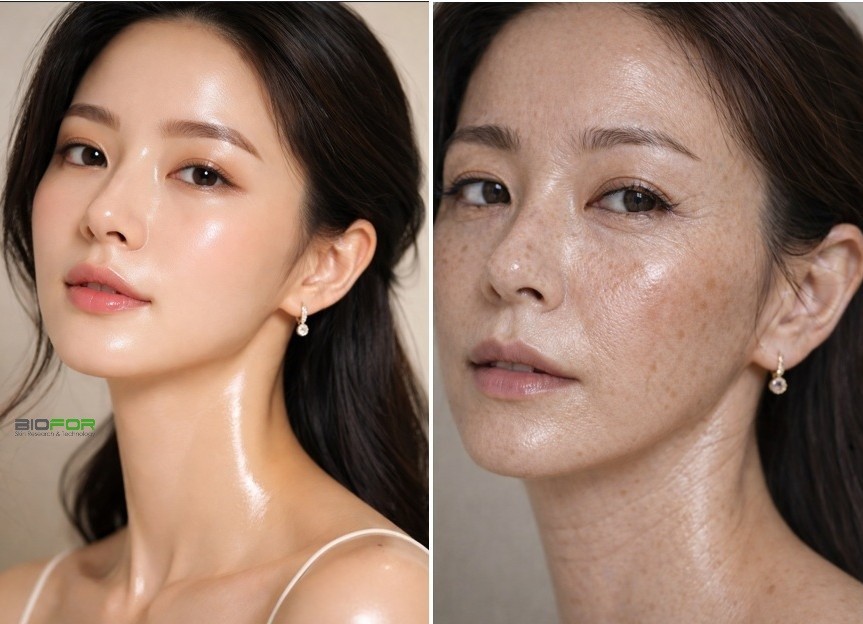
What exactly is glass skin?
What makes skin look so clear and luminous?
Glass skin is skin that is extremely smooth and radiant. This glowing effect is the result of several specific characteristics in the physiology and structure of the skin.
If we break it down, we are talking about skin that has little to no visible pores. Skin that is perfectly smooth, without roughness. Skin cells that contain enough moisture to appear full and soft. Skin tone that is even, without pigmentation. And finally, skin without fine lines or texture irregularities.
When the surface of the skin is smooth and uniform, light reflects from it evenly. This is what creates that luminous, glossy appearance.
In other words, glass skin is not one feature.
It is the combination of several skin qualities working together.
Each of these qualities can indeed be improved with cosmetic ingredients. But different ingredients address different issues.
Some ingredients help reduce the appearance of enlarged pores.
Others increase hydration.
Some target pigmentation and uneven skin tone.
Others improve texture and soften fine lines.
These are not trendy discoveries. Professionals and cosmeticians have been using such ingredients for decades. They are well known in cosmetic science and widely used in clinical skincare with excellent results.
So if we simply apply a “glow cream” or a product that creates a polished effect, will we achieve glass skin?
Not really.
When we aim for glass skin, we do not take skin that already has common concerns and simply add shine on top. If we did that, we would actually emphasize the imperfections.
Even a polished floor does not begin with polishing. First the foundation is laid. Then the surface is smoothed. The tiles are installed and aligned. Everything is cleaned. Only then comes the final polish.
Glass skin works the same way. It is the final result of many improvements that happen beforehand.
So is there one cream that can bring us closer to the glass skin dream?
This is the most important point to understand: each of us has different skin characteristics that may stand between us and that glass skin look.
For one person it might be enlarged pores. Her skin tone may be even, she may have no pigmentation, no wrinkles, good hydration and healthy cells. But she has visible pores.
Have you ever seen glass skin with enlarged pores? Probably not. One of the classic features of glass skin is nearly invisible pores.
Another person may have smooth skin and small pores but struggle with pigmentation. Have you ever seen glass skin with noticeable spots? Again, probably not. Glass skin also means an even skin tone.
The same applies to fine lines, rough texture, acne scars, comedones, dryness, dull skin or breakouts. Glass skin does not coexist with these issues.
So what does that tell us?
Each of us needs to address the specific issues that exist in our own skin in order to move closer to that glass skin appearance.
Which brings us to the obvious question:
Can a single cream solve all of these different issues?
The answer is no.
And even more importantly, we do not all have the same list of aesthetic concerns. Each person has areas where their skin looks beautiful and others where improvement is needed.
The idea that one or two creams are a universal magic key for everyone simply does not make sense.
Anyone who wants to approach the glass skin look will need different ingredients and sometimes different treatments. And now you understand why.
So what actually works?
Seeing a good and experienced cosmetician. And the emphasis here is on good.
Choose your professional carefully. Have a proper skin analysis. Ask for the result you are hoping for, and hear honestly how close your skin can realistically get to that look. Not everyone will achieve true glass skin.
But almost everyone can significantly improve their skin’s appearance when the real concerns are treated correctly and in a targeted way.
A skilled cosmetician has both the knowledge and professional products that are not available on store shelves. She can select the ingredients that are truly right for your skin, give you personal usage instructions, and guide you through the process with follow up and care.
And that is how you move, step by step and intelligently, toward the most beautiful skin your skin can be.