Rosacea: A Common Condition with a Significant Aesthetic Impact
Rosacea is a chronic inflammatory condition that primarily affects the facial skin. A large meta analysis including more than 26 million people estimated its prevalence at approximately 5.5% of the adult population. A substantial proportion of the studies included in that analysis were conducted in Europe. Rosacea affects both men and women, although it has been reported more frequently in women, with many studies showing the highest prevalence between the ages of 45 and 60.
Clinically, rosacea may present with persistent central facial redness, episodes of flushing, visible dilated blood vessels, papules and pustules, as well as sensations of heat, tingling, burning and increased sensitivity to skincare products and environmental changes. Some patients also develop ocular symptoms. In certain cases, progressive thickening of the skin may occur over time, most commonly around the nose.
The course of rosacea is often influenced by triggers that can intensify symptoms. These may include sun exposure, heat, rapid changes in temperature, hot drinks, spicy foods, alcohol, emotional stress and intense physical activity. The trigger profile is highly individual, which makes it more useful to identify the factors that affect each patient rather than impose a universal list of restrictions.
The condition can also have a considerable psychological and aesthetic impact. Studies have shown that rosacea may affect self image, confidence, social interactions and quality of life, even when the disease itself is not classified as severe.
This is where the cosmetician can make a meaningful difference. A woman with rosacea still wants her skin to feel hydrated, look radiant and smooth, and age well. Our role is to help her achieve these goals while respecting the limits set by the underlying skin condition.
The Four Traditional Subtypes, and the More Current Approach
For many years, rosacea was divided into four clinical subtypes.
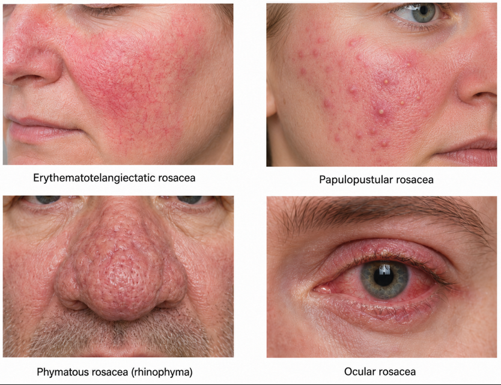
Erythematotelangiectatic rosacea
Characterised mainly by central facial redness, flushing and visible dilated blood vessels.
Papulopustular rosacea
Presents with inflammatory papules and pustules in addition to redness, which is why it can sometimes be mistaken for acne.
Phymatous rosacea
Characterised by gradual thickening of the skin and enlargement of the sebaceous glands. The best known manifestation is rhinophyma, involving changes in the structure and thickness of the skin of the nose. This form is more common in men.
Ocular rosacea
Affects the eyes and eyelids and may present with dryness, burning, a foreign body sensation, redness, tearing and inflammation of the eyelid margins.
This classification is still useful for learning and clinical orientation. However, the current international consensus has moved towards a phenotype based approach. The reason is simple: real patients do not always fit neatly into a single category. The same patient may present with persistent erythema, telangiectasia, flushing and papules, while at another point in time one feature may become more dominant than the others.
What am I seeing today? Is the skin calm? Does it feel hot? Is there active flushing? Are inflammatory lesions present? Is the skin barrier impaired? Does almost everything the patient applies cause stinging or burning?
Looking closely at the skin’s current condition helps us make more precise decisions about both in clinic treatment and the products recommended for home care.
Papules in Acne and Rosacea
Distinguishing acne vulgaris from papulopustular rosacea is particularly important for the cosmetician, because treatments commonly used for acne may be too aggressive for skin affected by rosacea.
One of the simplest and most useful clues is the presence of comedones. In acne, open or closed comedones are common. In rosacea, they are not a typical feature of the condition.
| Aspect | Acne | Papulopustular rosacea |
|---|---|---|
| Typical age | Common in adolescents and young adults; can persist into adulthood | More common in adults aged 30–50 |
| Distribution | Face and also chest/back/shoulders | Central face (nose, cheeks, chin, forehead); sometimes periorificial |
| Comedones | Typically exist | Absent in rosacea |
| Typical lesions | Papules/pustules plus nodules/cysts | Superficial papules and pustules; nodulocystic lesions rare |
| Vascular component | Not dominant; no flushing as a feature | Persistent background erythema, flushing, telangiectasia |
| Environmental triggers | Less affected by classical external triggers | Exacerbated by UV, heat, cold, alcohol, spicy food, weather changes |
| Ocular involvement | Rare | Frequent (burning/red eyes, tearing, photophobia) |
| Skin barrier & hydration | Tends toward higher sebum; lower TEWL | Dry/sensitive skin; higher TEWL, lower hydration and lipid levels |
| Central pathogenesis | Excess sebum via androgens, hyperkeratinization, C. acnes, inflammation | Dysregulation of innate immunity and vascular factors; TLR2–KLK5–LL-37 pathway |
| Associated microorganisms | Cutibacterium acnes (dominant) | Overgrowth of Demodex mites and/or S. epidermidis involvement |
| Scarring/thickening | Scars common | Scarring less common; may develop phymatous changes (e.g., rhinophyma) |
The overall clinical picture is also different. Rosacea tends to affect the central face and is often accompanied by persistent redness, flushing, visible blood vessels, burning or increased sensitivity. Acne may also involve the forehead, jawline, chest and back, and is often associated with oily skin and follicular blockage.
A good history can be just as informative as visual examination. A patient who says that her face “burns” after a glass of wine, becomes very red in hot environments, stings after the use of certain skincare products, and then develops papules against a background of diffuse redness should raise suspicion of rosacea.
The cosmetician is not expected to make the medical diagnosis. She should, however, recognise when the clinical picture does not behave like typical acne and refer the patient for medical assessment when needed.
Treat the Skin You See Today
With rosacea, the condition of the skin at the time of the appointment matters greatly. Skin that has been stable for months is very different from the same patient’s skin during a flare.
When there is marked redness, heat, burning, increased flushing or an active inflammatory episode, the priority is to calm the skin and protect the barrier. This is not the right time for procedures designed to renew the skin through controlled irritation.
During periods of active redness or inflammation, it is advisable to avoid significant peels, scrubbing, microdermabrasion, abrasive exfoliation, prolonged heat or steam, aggressive massage, and any technology or procedure that is ablative, wounds the skin, creates controlled thermal injury or deliberately induces inflammation.
When the condition is calm and the skin barrier is stable, the range of treatments can gradually be expanded. Even then, it is wise to begin with lower concentrations of acids and gentler procedures, while paying close attention to the skin’s response.
It is also important to avoid arbitrary numerical rules. There is no universal scientific concentration above which a particular acid suddenly becomes “forbidden” in rosacea. The same formulation may be well tolerated by one patient and cause significant burning in another.
The decision therefore needs to be based on a clinical reading of both the product and the skin. How gentle is the formulation as a whole? Does it contain the free acid or a less aggressive derivative? Is the pH close to neutral or strongly acidic? Is the vehicle a potentially drying gel or a richer, more emollient cream? How long does the product remain on the skin? How often is it actually used? And most importantly, is the patient’s skin barrier currently stable, or is it already irritated and more permeable than usual?
The Skin Barrier Is Central in Rosacea
One of the important findings to emerge in recent years is that rosacea is also associated with significant impairment of the epidermal barrier. Studies have reported changes in barrier proteins, intercellular lipids and the organisation of tight junctions, together with increased transepidermal water loss and greater skin sensitivity.
This is one of the areas where the cosmetician can make a real difference. She has a wide range of tools that can directly support the skin barrier, through appropriately selected professional treatments, through careful choice of products for home care, and above all through the professional knowledge that allows her to understand what the skin needs at each stage.
Once we understand the physiology of rosacea and the role of barrier dysfunction, it becomes clear that cosmetic care can also have an important functional role.
The approach begins with the basics. Cleansing should be gentle. In some patients, a traditional cleanser can be replaced with micellar water that is free from SLS and other harsh detergents. A suitable moisturiser is essential, together with ingredients that support the lipid structure of the stratum corneum.
Niacinamide is also particularly useful in this context. It has been shown to support ceramide and epidermal lipid synthesis and to reduce transepidermal water loss. In a clinical study involving patients with rosacea, a moisturiser containing niacinamide improved measures of barrier function as well as the overall condition of the skin.
Panthenol, or vitamin B5, is another useful barrier supporting ingredient. Potassium azeloyl diglycinate, PAD, a gentler derivative of azelaic acid, can also be a valuable addition to formulations designed to support hydration, strengthen barrier function and help maintain more balanced skin behaviour.
Azelaic Acid: An Important Link Between Medical and Cosmetic Care
Azelaic acid deserves special attention. It is widely used in professional skincare, and at concentrations of 15% to 20% it is also a well established treatment for papulopustular rosacea.
Its activity in rosacea is mainly related to its anti inflammatory effects. Research has shown an influence on pathways involving NFκB, cytokines and reactive oxygen species, as well as on kallikrein 5 and cathelicidin, both of which are involved in the inflammatory pathophysiology of rosacea.
For the cosmetician, there is an important practical point here. An ingredient can be highly beneficial biologically and still cause some initial stinging, burning, dryness or redness. These local reactions are well recognised with products containing 15% azelaic acid. When they occur, frequency or amount may sometimes need to be reduced, or treatment paused temporarily, according to the physician’s guidance.
What About Retinoids?
Retinoids are among the most valuable ingredients available for improving signs of ageing, skin texture and the behaviour of both the epidermis and dermis. This naturally makes them relevant to many patients with rosacea who also want to address age related skin changes.
The main consideration is their potential to irritate.
The evidence regarding retinoid use in rosacea is not entirely consistent. There is some support for medical use of retinoids, particularly systemic isotretinoin in selected cases, while the evidence for topical retinoids remains limited and mixed.
From a cosmetic treatment perspective, when the barrier is impaired or the skin is currently reactive, it is advisable to avoid introducing topical retinoids at concentrations intended to produce visible skin renewal.
In a stable patient who also wants to treat signs of ageing, a retinoid may be introduced cautiously, starting with a low concentration and low frequency while closely monitoring the skin response. The goal is not to increase frequency as quickly as possible, but to gain the benefits of the retinoid without reactivating the cycle of irritation and inflammation.
It is also advisable to support retinoid use with a well formulated moisturiser that nourishes and protects the skin barrier and, where possible, includes soothing or anti inflammatory ingredients. Examples include Centella asiatica, Dunaliella, green tea, carotenoids, antioxidants and selected minerals with soothing properties.
The moisturiser should also provide strong barrier support through ingredients such as ceramides, glycine, essential fatty acids, urea and hyaluronic acid.
Understanding the Medications Prescribed by the Physician
The cosmetician does not prescribe medication, but she should know exactly what the patient is using. This knowledge makes it possible to build a sensible home care routine around the medical treatment, including the correct order of application, and to anticipate possible effects such as dryness, burning or mild irritation.
When a topical medical treatment is prescribed, it should generally be applied first in the home care routine. After cleansing, the medication is usually applied to clean, dry skin, while always following the specific instructions provided by the physician and the product leaflet. Once the medication has absorbed and dried, a moisturiser, or a serum followed by a moisturiser, can be applied.
For example, the official instructions for topical ivermectin allow cosmetic products to be applied after the medication has dried. With topical metronidazole, non astringent and non comedogenic cosmetic products may also be used after application.
If the physician provides different instructions, those instructions should of course take priority.
Sun Protection Is Part of Rosacea Care
UV exposure is a well recognised trigger that can aggravate rosacea. Daily sun protection is therefore an important part of the skincare routine.
The practical challenge is tolerance. A sunscreen may provide excellent theoretical protection, but if it causes stinging or discomfort, the patient is unlikely to use it consistently or in a sufficient amount. The aim is to find a formulation that the patient can tolerate comfortably and use every day.
Some sunscreens use encapsulated chemical UV filters. In these formulations, the filter is enclosed within a carrier system rather than remaining in direct contact with the skin. This can help reduce direct exposure of sensitive skin to the filter itself and may improve tolerability in some patients. Encapsulation may also help limit interactions associated with reactive species generated during UV absorption, depending on the formulation and delivery system.
For a patient with rosacea who reacts easily to sunscreens, trying a well formulated product using encapsulated UV filters may therefore be a useful option.
The Cosmetician as Part of the Care Team
Rosacea is an excellent example of how professional knowledge can change the entire cosmetic treatment plan, especially when cosmetic care is closely linked to ongoing medical treatment.
The cosmetician does not replace the dermatologist, nor does she treat the disease instead of the physician. She treats a person whose skin is affected by a chronic condition and who may continue to visit the clinic for many years for a wide range of aesthetic concerns.
The better she understands what is happening in the skin, the better her decisions can be.
She can recognise a suspicious clinical picture and refer the patient for medical assessment. She can distinguish between a flare and a stable phase. She can avoid unnecessary irritation, support the epidermal barrier, choose appropriate cleansing and moisturising products, understand the implications of the patient’s medication, and introduce active ingredients carefully when the skin allows it. She can also address signs of ageing, texture and overall skin appearance without losing sight of the underlying physiology.
For the patient, this makes a real difference. She does not have to choose between medical management of rosacea and caring for the appearance of her skin. When the physician and cosmetician each work within their own professional scope, with a shared understanding of the same skin, much more can be achieved: calmer skin, a stronger barrier, less irritation, improved appearance and a skincare routine that can be maintained comfortably over time.