
Treating the Skin of Women Undergoing Chemotherapy
When a woman undergoes chemotherapy, her skin is not simply “more sensitive” in the usual cosmetic sense. It is in a different biological state. Chemotherapy targets rapidly dividing cells, and the skin is one of the first organs affected, because skin cells constantly devide.
What happens to skin during chemotherapy?
The rate of keratinocyte proliferation decreases, epidermal renewal slows down, and the skin’s ability to repair itself is impaired. At the same time, the skin barrier is damaged: intercellular lipids are reduced, trans epidermal water loss increases, and the skin becomes permeable, reactive, and unstable.
It is important to understand that this change is not always visible. The skin of a woman undergoing chemotherapy may look calm, smooth, even “fine”, but functionally it is fragile. Slower keratinization, a very low irritation threshold, and a tendency toward subclinical inflammation are common. For us as practitioners, this means that even minimal irritation, an active ingredient that would be well tolerated by another client, or a treatment that appears gentle, can lead here to stinging, persistent redness, barrier damage, and most importantly, post-inflammatory hyperpigmentation.
Many women undergoing chemotherapy suffer from significant dryness, a feeling of tightness, itching, tingling, and sometimes peeling. The skin loses its ability to “hold” treatments. In addition, pigment system reactivity is increased. In women who are already prone to pigmentation, even a minor trigger can cause pigmentation, and this risk increases further under biological stress such as chemotherapy. Chemotherapy drugs themselves may also cause direct pigmentation or increase photosensitivity.
Therapeutic approach
Based on this understanding, the therapeutic approach must change. During chemotherapy, your goal is not to improve texture, clear existing pigmentation, or “treat” the skin in the conventional sense. The goal is to preserve proper function. To stabilize, protect, reduce inflammation, and prevent future damage. Correct care during this period affects not only how the client feels now, but also the condition of her skin months and even years later.
In the clinic
In the clinic, avoid aggressive treatments of any kind, including heat-based treatments, Microneedling, IPL, lasers, aggressive extractions, or mechanical friction. Do not give home exfoliators, even mild ones, with alpha and beta hydroxy acids, retinoids. All of these are unsuitable for skin undergoing chemotherapy, even if it “looks fine”. Remember that the skin cannot cope with controlled injury during this period.
Choosing active ingredients
Precision is also essential when selecting active ingredients. There is no absolute medical contraindication to using brightening agents such as tranexamic acid, arbutin, or phenylethyl resorcinol, but the question is not only whether they are “allowed”, but whether the skin can tolerate them and at what concentration without irritation. Tranexamic acid and phenylethyl resorcinol are considered gentler and are not inherently photosensitizing or strongly irritating, and may therefore be suitable in certain cases, especially when the skin is intact, calm, and without signs of irritation. Arbutin is possible at low concentrations, and today only low concentrations are permitted. Kojic acid, although not medically dangerous, is considered more irritating, and in chemotherapy-treated skin it is usually preferable to choose a different option.
Which ingredients should be avoided entirely? Exfoliating acids, retinol, ascorbic acid, volatile alcohols, fragrance, and irritating botanical extracts. It is not recommended even to perform “small tests” or “trial applications”.
Managing existing pigmentation
Pigmentation management during this period is primarily preventive. Do not attempt to “treat the spot”. Prevent irritation. Protect the skin from the sun with a broad-spectrum SPF every day. Any minor inflammation that is not managed correctly can turn into pigmentation.
Among Biofor products, it is preferable to use Spotless rather than Skin Tone if the skin appears dry and stressed. Light Cream can be an excellent addition for melanin balance. If the skin is dry or requires barrier repair, it is better to replace Light Cream, which has a light-to-medium texture, with Skin Active. And of course, do not use Biofor exfoliating products during chemotherapy treatments.
Choosing Biofor products for skin during chemotherapy
Skin Active is excellent for restoring the epidermal barrier, encouraging healthier cell division, and improving overall skin vitality. Another cream that contributes to skin vitality and healthy cell turnover is Ampoulight, even without ampoules. It contains dipalmitoyl hydroxyproline, which improves skin metabolism and restores its function. The ampoules that may benefit chemotherapy patients are Soft, Moist, Defense, and Ageless.
Calming is an excellent supportive treatment for skin during chemotherapy. It restores and softens the skin, strengthens the skin barrier, and combats the subclinical inflammation that characterizes the skin during this period. The longer it remains on the skin, the better. When the client is at home, and also overnight.
Serums: all three of our serums support skin under stress due to chemotherapy. C Serum functions as an antioxidant, anti-inflammatory, enhances hydration, and induces collagen production. Pro Lift supports skin renewal, a process that is slowed during chemotherapy, and also provides strong hydration support. Vita+ Serum replenishes essential fatty acids in the skin and delivers vitamins that help fight subclinical inflammation.
Our Soapless Soap can be used during this period. Although it contains acids, it is a tiny amount, and it is not drying. Remember that we immediately support the skin with other therapeutic Biofor products, so this is acceptable. It is always possible to use Gentle Clean as well.
The human aspect
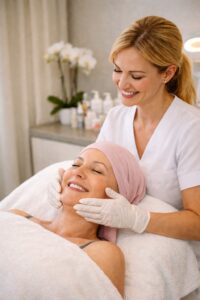
Finally, we must also remember the human aspect. A woman undergoing chemotherapy experiences significant physical and emotional stress. Proper cosmetic care for her is supportive care. Its purpose is to ease, soothe, preserve quality of life, and not add another struggle to skin that is already coping. There is no need to “achieve results” of the type we usually show in before-and-after photos. The goal is maintenance of healthy skin. And most importantly: our hands, our positive energy, and the act of caring touch are healing for the skin no less than the active ingredients themselves.